A while ago, during a workshop we organized for an international lifestyle group, I had the chance to sit through sessions led by Enrico Dessì and Luca Lisci.
I’ll probably write about both of them properly at some point. They’re two of the people I admire most professionally, and almost every time I listen to them I leave with at least one idea I want to steal, test or build on.
This time, what stuck with me was how they were using AI to look at companies and teams.
Not “ask ChatGPT to summarize this document” AI.
Actual process work.
Structured interviews. Breaking a workflow down. Understanding where information gets lost, where decisions slow down, where people behave differently, and then turning all of that into something you can actually act on.
That session made something click for me:
If your idea of using AI at work is opening ChatGPT and asking it a few clever questions, you’re probably still only scratching the surface.
A lot of the interesting work happens before the prompt: understanding the system, asking the right questions, structuring information and deciding what should actually change.
From personality tests to teams
It also reminded me of something I’ve seen in almost every company I’ve worked with.
At some point, someone does a personality test.
You discover that you’re an INTJ, a yellow-red-whatever, everyone compares results over coffee for a week… and then life goes on exactly as before.
The test tells you something about you.
What I always found more interesting was the next question:
What does the mix of all these people mean for the team?
So I built Team Map.
It’s a small, free tool for team leaders, HR people or simply curious teams.
You create a session, share a code and everyone answers 50 short statements from their phone. It takes around eight minutes and can be done in different languages.
Each person sees their own profile first.
Then — only if they want to — they can anonymously contribute four numbers to the team map.
No names. No rankings. No individual leaderboard.
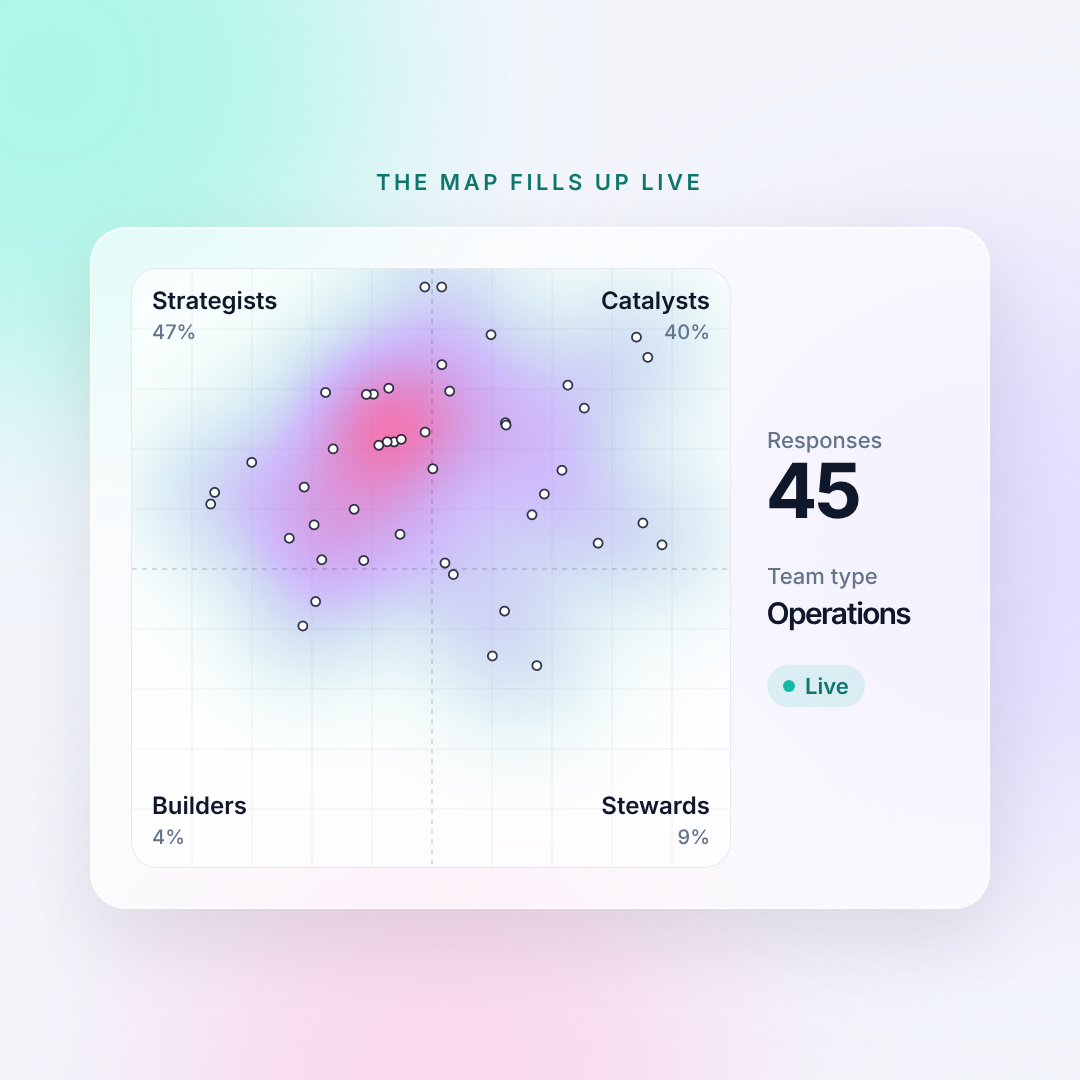
Once enough people participate, the map starts filling up live.
And that’s the part I was interested in building.
Not another personality label, but a way of asking:
- Are we heavily concentrated in one type of behaviour?
- Is that useful for the work this team actually does?
- Where could the composition create friction?
- What could we try changing over the next 30 days?
Team Map turns the aggregate into a few priorities, suggested actions, KPIs, a SWOT and a simple debrief format.
It’s not supposed to tell you who is good or bad at their job.
It’s supposed to start a better conversation about how the team works.
The boring part that actually matters
Because this is a tool about people, I spent quite a bit of time thinking about what it shouldn’t do.
Participants don’t create accounts. No names or emails are attached to their answers. Individual questionnaire responses stay on the device, and only aggregate profile dimensions can be shared with the team.
The team map doesn’t even appear until there are enough responses to make singling someone out harder.
There is also no AI model judging employees behind the scenes.
The questionnaire is based on the public-domain IPIP Big Five, while the team-level insights come from explicit rules rather than an AI deciding whether somebody is a “good fit”.
That constraint was intentional.
A tool like this should help people understand a team, not quietly become another employee-scoring system.
Credit where it’s due
Part of the thinking behind this experiment came directly from seeing the work of Enrico and Luca.
They’re involved in Forma Futura, an AI Transformation Studio focused on bringing AI into real organizational processes through process redesign, training, change management and AI integration.
If this topic interests you, their work is worth exploring: Forma Futura ↗
Team Map is obviously a much smaller experiment.
But building it was a useful excuse for me to take an idea I had seen during a workshop, understand it a little better, and turn part of that thinking into something tangible.
Which is usually how most of my side projects start.
Try it with your team
Just a map and, hopefully, a few useful questions.
Open Team Map → ← All personal projects