After building Rudle, I felt strangely inspired to waste even more AI credits on projects of almost no practical value.
I had a fever. I had finished work. I was definitely not in shape to go to the gym, and walking around Barcelona didn't sound like a particularly smart idea either. So I was stuck at home, bored.
One of the games I play when I'm bored and there's no connection is Google's Dino game: the pixelated dinosaur that runs through the desert, jumping over cacti and trying not to die.
Which, for some reason, felt like a very good starting point.
The idea was slightly too ambitious
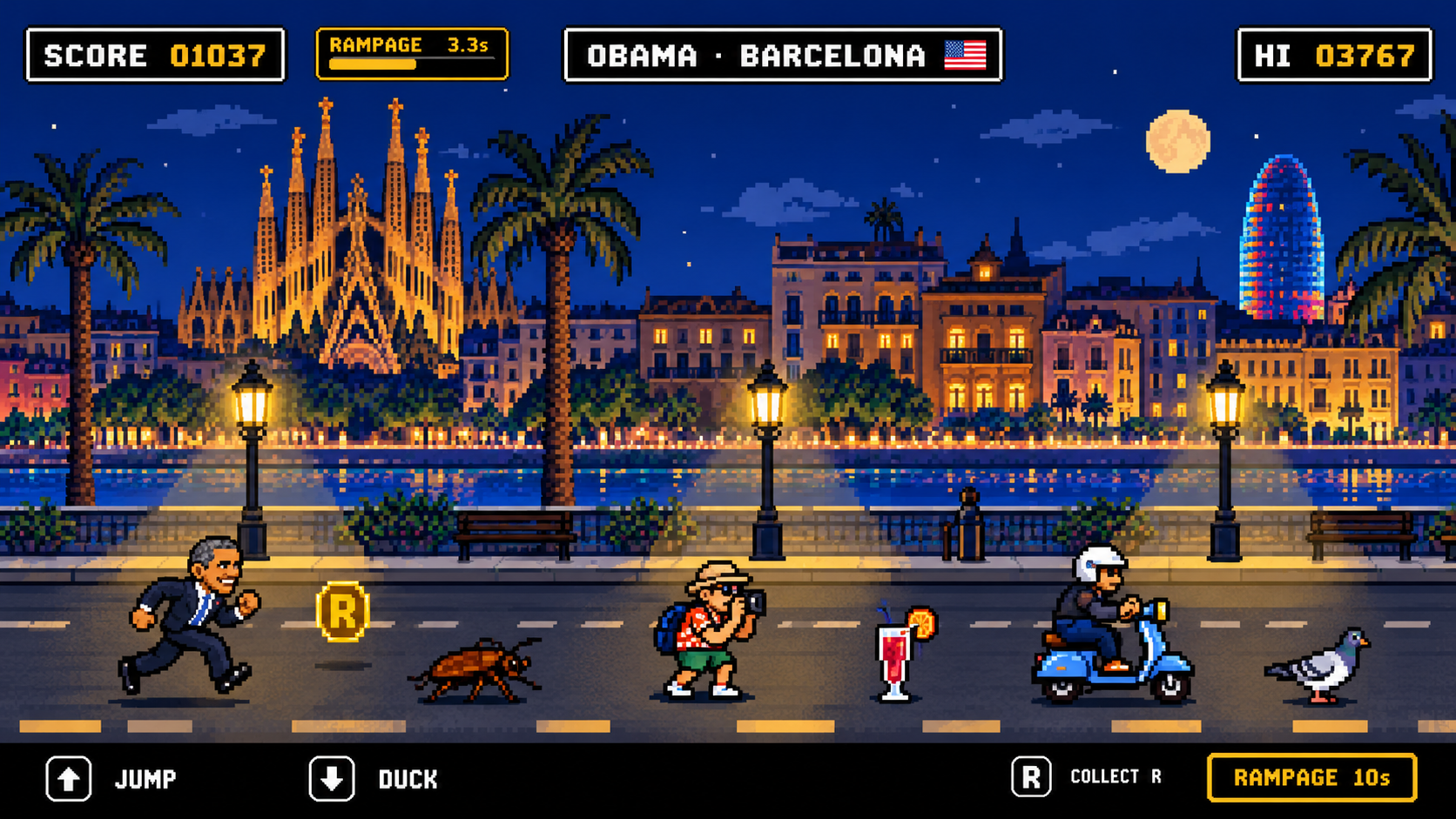
I wanted the same immediate logic — run, jump, survive — but turned into something much more stupid and much more Barcelona.
The image above was the original concept. A full 8-bit Barcelona skyline, recognizable characters, scooters, pigeons, street obstacles, collectibles, lamps, changing environments and the general feeling of running away from your problems.
Basically Google Dino, if Google Dino had moved to Barcelona and developed a questionable sense of humor.
19 attempts. Not joking.
I asked ChatGPT to help me build it. Then I started the loop that anyone who builds things with AI already knows: generate, test, notice something broken, explain why it's broken, regenerate, discover a completely new problem, repeat.
Nineteen attempts later — yes, I counted — we arrived at a version I could actually deploy.
Do I love the final game? Not really. There are still bugs. Some graphics aren't quite right. A few things behave in ways I definitely didn't design on purpose.
But it was the best I could produce while half-distracted, sick on the sofa and watching Nord Sud Ovest Est, the series about 883.
Then I did the obvious thing: I rebuilt it with another LLM
I still wasn't satisfied, so instead of doing something sensible, I asked ChatGPT to write a complete handover brief for Claude: the game logic, visual direction, mechanics, characters, obstacles, environments — basically everything we had learned through those 19 iterations.
Then I gave Claude the same challenge.
Claude, of course, immediately had opinions about some of the characters I wanted to include. Trump, Obama, Zuck... you get the idea. Classic Claude.
Still, it produced its own version of the game. And that made the whole experiment more interesting: same idea, roughly the same brief, two different LLMs, two different outputs.
Try both
I'm leaving both versions here. Neither is going to win Game of the Year, but maybe they'll kill a few minutes between meetings.
Both games open as standalone experiences, outside the portfolio interface.
What's next?
Now I want to try the exact same experiment with other LLMs.
Same concept. Same handover. No special treatment. Then see what each model actually manages to build.
Is this useful? Probably not.
Am I going to do it anyway? Almost certainly.